
How Often to Wash Baby? 3 Practical Schedules for Parents
This post contains affiliate links. As an Amazon Associate, we learn from qualifying purchases
How often to wash a baby breaks into three separate schedules: skin (2-3 times weekly for newborns), clothes (every wear for under-2-month-olds, every 2-3 wears for older babies), and feeding items (sanitize daily for under-2-month-olds, clean after each use for all). The baby’s age and health status, premature, under 2 months, or immunocompromised, override every standard frequency and demand hospital-grade hygiene at home.
That “depends” isn’t a cop-out. It’s the mechanical reality that a newborn’s skin barrier, an infant’s immune system, and a toddler’s daily grime operate on different biological clocks. A single blanket schedule misses the point.
What follows: three evidence-backed timetables for bathing, laundry, and bottle cleaning, each tied to a specific health threshold. You’ll also get the one physical rule that cuts your actual work in half, and the edge cases where skipping a step isn’t lazy, it’s necessary.
Key Takeaways
- Bathe a healthy newborn 2–3 times a week; daily baths strip natural oils and increase eczema risk. Increase frequency once they’re crawling and eating solid food.
- Sanitize bottles, teats, and pump parts daily if your baby is under 2 months old, premature, or immunocompromised. For older, healthy babies, a thorough wash after each use is sufficient.
- Wash all clothing, bedding, and cloth toys after a single wear or use for babies under 2 months. For older infants, outer layers can go 2–3 wears if not soiled, but bodysuits and socks are one-and-done.
- Complete drying is non-negotiable. Damp items grow bacteria and mold faster than dirty ones. Air-dry bottles on a clean paper towel, not a rack.
- Adjust every schedule immediately if your baby has a weakened immune system, active diaper rash, or is recovering from illness. Hygiene isn’t about routine; it’s about risk management.
The 3 Core Washing Schedules (Skin, Clothes, Gear)
You don’t have one washing problem. You have three. Treating them separately stops the overwhelm and lets you focus effort where the medical stakes are highest.
Baby’s Skin: The Bath Schedule
Newborn skin is not just small adult skin. Its acid mantle and stratum corneum are still forming, which is why overwashing causes more problems than it solves.
A healthy, full-term newborn needs a full bath only 2–3 times a week. Spot-clean the face, neck, hands, and diaper area at every change. This preserves the skin’s natural oils and microbiome. The switch point is mobility: once your baby is crawling on floors and smearing food, move to daily baths.
Where this goes sideways: Bathing a newborn daily in soapy water. By day ten, the skin feels dry and rough, and tiny patches of eczema often flare on the cheeks and chest. It takes a week of reduced washing with plain water to reset.
The water temperature matters less than the rinse. Use lukewarm water and a fragrance-free cleanser like Aveeno Baby Wash. The critical step is a thorough, clean-water rinse. Soap residue left on the skin is a direct irritant.
For the diaper area, wiping a baby girl front-to-back and wiping a baby boy with gentle folds is the real work. Whether you should you wipe after pee is a common question, for urine alone, a pat-dry with a soft cloth is often enough, but always wipe after stool.
Baby’s Laundry: The Clothing & Bedding Schedule
Laundry frequency is a direct function of skin contact and soil type. The official CDC hygiene FAQ document ties frequency to infant vulnerability, but the underlying mechanics are about bacterial transfer.
| Item | Baby Under 2 Months / Premature | Healthy Baby Over 2 Months | Why the Difference |
|---|---|---|---|
| Bodysuits, Socks | After every wear | After every wear | Direct contact with saliva, milk, urine. |
| Pants, Sweaters | After every wear | After 2-3 wears (if clean) | Less direct soil; watch for drool patches. |
| Bed Sheets, Swaddles | Twice weekly | Weekly | Accumulates skin cells, milk dribbles, sweat. |
| Cloth Toys | Wash before first use, then weekly | Wash before first use, then every 2 weeks | Mouth contact introduces oral bacteria to fabric. |
The “baby under 2 months” rule isn’t arbitrary. Their immune system is still calibrating. A peer-reviewed odor control study notes that microorganisms can survive for weeks in stored textiles, especially in humid conditions. This is why a hamper is a microbial incubator, don’t let dirty baby clothes sit for more than a day or two.
Use a detergent free of dyes and fragrances. The Miele “Baby Clothes” program, which runs at 60°C (140°F), is designed for this, as heat above 40°C is key for pathogen control. If your machine doesn’t have a sanitize cycle, use the hottest water the fabric allows and add a bleach alternative.
Feeding Items: The Bottle & Pump Schedule
This is the highest-stakes schedule, and it’s binary. The CDC infant feeding item hygiene guide draws a bright line: If your baby is under 2 months old, was premature, or has a weakened immune system, sanitize bottles, teats, and pump parts daily. For older, healthy babies, washing with hot, soapy water after each use is acceptable.
The “sanitize” step means using a steam sterilizer, boiling in water for 5 minutes, or using a dishwasher with a sanitizing cycle. The Miele washer-disinfector, for example, has a dedicated “Baby bottles” program with thermal disinfection.
Never add fresh formula to a partially used bottle. Discard any unfinished milk within 2 hours of starting a feed. The bacteria from your baby’s mouth multiply rapidly at room temperature.
For breast pump parts, the guidance is similar but emphasizes drying. A joint report from the Healthcare Infection Society states that for kits reused by the same mother, “detergent washing in warm water, thorough rinsing, and complete drying after each use is considered acceptable decontamination.” The drying is the guard against water-borne bacteria.
Health Exceptions That Override Every Rule
Standard schedules are for standard babies. Three health conditions reset all timers to “hospital cautious.”
Premature or Under 2 Months Old: This isn’t just about size. The skin barrier and immune function are underdeveloped. Sanitize all feeding items daily. Bathe only 1–2 times a week with water only, unless directed otherwise by your pediatrician. Wash all clothing and bedding after a single use.
Immunocompromised: This includes babies undergoing chemotherapy, with HIV, or with certain genetic conditions. Their hygiene protocol mirrors a neonatal intensive care unit (NICU). You may be instructed to use a 2% chlorhexidine (CHG) no-rinse bathing cloth for skin cleansing, which reduces bacterial load on the skin better than soap and water. All items require sterilization, not just sanitation.
Active Infection or Diaper Rash: During a bout of thrush, gastroenteritis, or a severe diaper rash, escalate cleaning for the duration. Sanitize feeding items and teethers daily. Change clothing and bedding more frequently to avoid reinfection. For diaper rash, skip wipes altogether and rinse the area with warm water, then pat completely dry before applying barrier cream.
In these cases, the goal isn’t convenience. It’s creating a buffer between your baby and pathogens their body can’t yet handle.
Why Drying Is Half the Battle
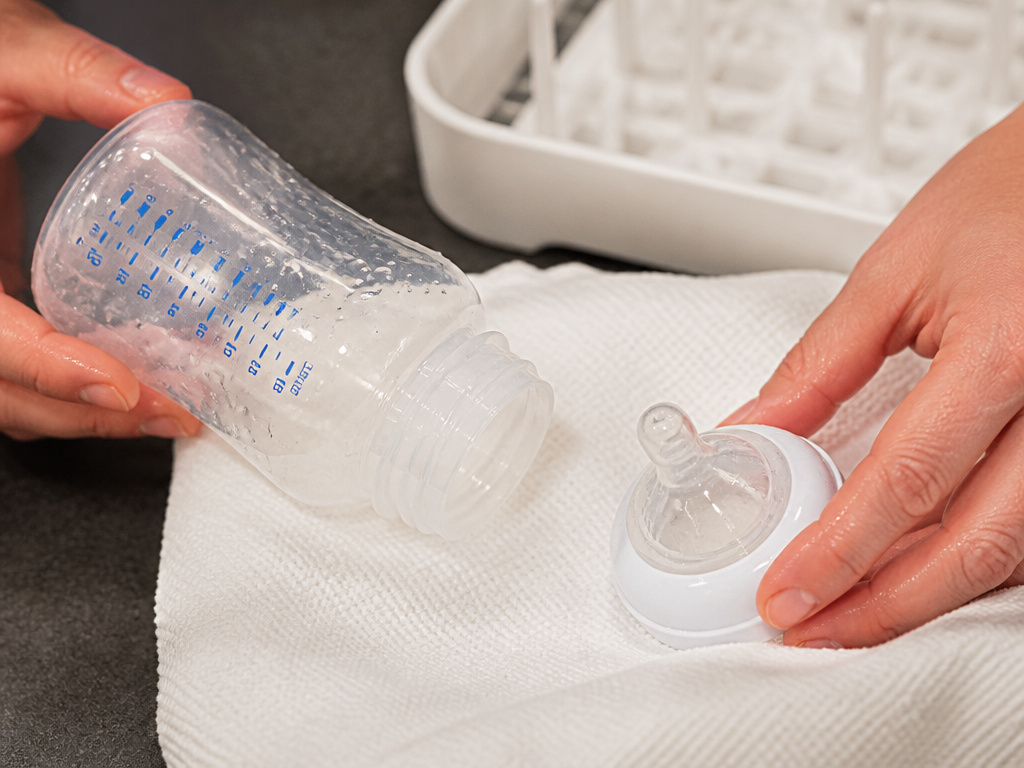 Cleaning removes soil. Drying removes the water that bacteria and mold need to grow. A damp bottle teat is more dangerous than a dry, used one.
The part nobody mentions: Drying racks are a trap. Their crevices hold moisture and grow mold. Air-drying items on a clean, dry dish towel or paper towel is more hygienic. If you must use a rack, wash and sanitize it every few days.
The German Federal Institute for Risk Assessment (BfR) emphasizes that prepared formula must be used immediately or stored below 5°C for a maximum of 24 hours, a rule that exists because moisture and nutrients together are a perfect bacterial culture. The same principle applies to a wet washcloth left in a tub or a damp hoodie in the laundry hamper.
For laundry, always dry items completely before folding and storing. That PMC laundry science article is clear: storing laundry in a humid environment allows odor-producing and potentially pathogenic bacteria to thrive for weeks.
Machine vs. Hand Washing: When Each Actually Wins
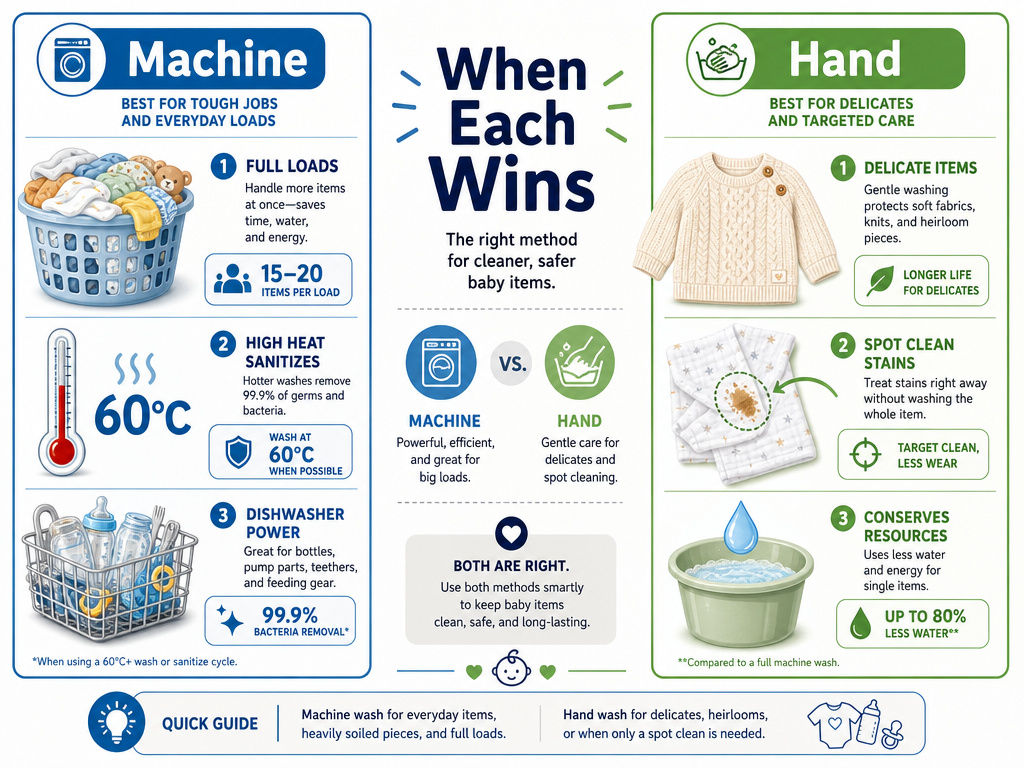 Your tools change the timeline. Hand washing is a physical process with high variance; machine washing is a controlled thermal and chemical process.
Choose Machine Washing When:
- Volume: You have a full load of baby clothes, sheets, or cloth toys. A washing machine’s agitation and consistent high temperature are superior.
- Sanitization is required: Your baby is in a high-risk category. A machine with a sanitize cycle (like the Miele “Baby Clothes” at 60°C) provides verifiable thermal disinfection.
- For feeding items: Only if your dishwasher has a certified sanitizing cycle and you use a dedicated basket for small parts. The Miele washer-disinfector is the professional standard here.
Choose Hand Washing When:
- For delicate items: A hand-knit wool sweater or a silk-lined bonnet.
- For immediate spot-cleaning: A blowout on a swaddle while traveling.
- When a machine isn’t available: The CDC’s emergency guidance outlines how to hand-wash and sanitize feeding items using boiled water and bleach solution when utilities are down.
The trade-off is certainty. A machine cycle is reproducible. Hand washing depends on your water temperature, diligence, and rinse technique. If you’re hand washing a critical item, be militant about the final rinse and dry.
The Product Shortlist: What to Actually Use
Your schedule is only as good as the products that execute it. Harsh chemicals create new problems.
For Skin: A fragrance-free, dye-free liquid cleanser. Aveeno Baby Wash is a mainstream benchmark. For wipes for sensitive skin, look for brands like WaterWipes that are water-only baby wipes. Newborn wipes should be even simpler, often just cloth and water.
For Laundry: A “free and clear” liquid detergent. Tide Free & Gentle or All Free & Clear are widely available. Avoid detergent pods for baby loads, the concentrated gel can leave residues if it doesn’t fully dissolve.
For Feeding Items: A dedicated bottle brush with a stand that allows it to air-dry. A large, clean basin used only for baby items. For sanitizing, an electric steam sterilizer is faster and more energy-efficient than boiling.
Skip the baby powder for diaper rash. Modern barrier creams with zinc oxide are more effective and avoid inhalation risks.
Frequently Asked Questions
How often should I wash my baby’s hair?
For newborns, once a week is plenty. Use a drop of baby shampoo, lather gently on the scalp, and rinse thoroughly. Cradle cap is often worsened by overwashing, not improved by it.
Can I wash baby clothes with regular detergent?
You can, but you shouldn’t. Regular detergents contain optical brighteners, fragrances, and dyes that are common skin irritants. A “free and clear” formula removes a major variable if your baby develops a rash.
Do I need to wash new baby clothes before using them?
Yes, always. New textiles contain sizing chemicals, dyes, and dust from manufacturing and shipping. Wash them on a gentle cycle with baby detergent before the first wear.
How often should I clean the baby bathtub?
Clean it after every use. Rinse it with hot water, wipe it down with a mild soap, and let it air-dry completely. Once a week, give it a more thorough scrub. Mold grows in the film left by bath water and soap.
Is it okay to use hand-me-down clothes without washing them?
No. Even from a trusted source, stored clothing collects dust mites, mold spores, and residual detergent from the previous family’s routine. Wash everything before it touches your baby’s skin.
Before You Go
How often to wash a baby isn’t a quiz with one right answer. It’s a set of three parallel schedules, skin, laundry, gear, each governed by your baby’s age and health. The universal rule is dryness: a completely dry item is a safe item. Escalate everything if your baby is premature, under two months, or immunocompromised. For a healthy, older infant, trust that a little dirt is okay. Your sanity is part of the hygiene equation, too.
