
Should You Wipe Baby After Pee | The Science-Backed Answer
This post contains affiliate links. As an Amazon Associate, we learn from qualifying purchases
You do not need to wipe your baby after every pee. Modern superabsorbent diapers keep skin dry, and urine alone is rarely irritating. The American Academy of Pediatrics states wipes are primarily for cleaning poop. For a quick pee change, patting the area dry with a clean cloth is often enough.
That “pee is rarely irritating” line from the pediatrics authority changes the math. It means the old rule, wipe every single time, was built on worry, not evidence. The real problem is the chemical reaction that starts when urine and stool mix inside the diaper.
This guide breaks down the science of skin pH, the specific wipe ingredients that matter, and the one scenario where skipping the wipe guarantees a rash. You’ll get a clear decision framework, the clinical data on wipes versus water, and the simple check to know if your baby needs that extra step.
Key Takeaways
- Wiping after every pee is unnecessary and can dry out sensitive skin. Reserve wipes for bowel movements.
- The main cause of diaper rash is elevated skin pH from urine-stool mix, which activates harsh fecal enzymes.
- Clinical studies show pH-buffering wipes (like Pampers Sensitive) maintain healthier skin pH than water and a washcloth.
- Always ensure the skin is completely dry before putting on a new diaper, whether you use a wipe or not.
- In licensed childcare settings, regulations often mandate cleansing at every change, so the rules are different.
The Short Answer: It Depends (But Usually No)
The direct answer hinges on two things: what’s in the diaper and your baby’s skin. For a diaper containing only urine, you can usually skip the wipe. If there’s any stool, you must wipe.
Where this goes sideways: Assuming all moisture is the same. Urine in a modern diaper is mostly pulled into the absorbent core. The residual dampness on the skin is the issue, not the urine itself. Pat it dry.
This approach avoids fixing what isn’t broken. Superabsorbent polymers in diapers lock moisture away.The AAP’s guidance is clear: “pee is rarely irritating” and wipes are for poop. Adding a wipe when it’s not needed introduces friction and potential irritants to skin that’s already fine.
But “usually no” has a critical exception. If your baby has very sensitive skin, a history of rashes, or is in the middle of a diarrhea episode, the calculus shifts. In those cases, a gentle, pH-buffering wipe can be a protective step, even for pee, to manage skin pH proactively. The goal is always a clean, dry surface.
Why Skin pH is the Real Boss
Diaper rash is a chemistry problem. Healthy baby skin has a slightly acidic pH, between 4 and 6.This acidic environment keeps the skin’s barrier strong and suppresses the activity of certain enzymes found in stool.
When urine and stool mix in a diaper, the pH can shoot up to between 7.5 and 9, neutral to alkaline. This pH shift acts like a switch, activating those fecal enzymes (lipase and protease) that then start breaking down the skin’s protective lipids. The result is irritation, redness, and the classic diaper rash.
Water alone cannot stop bacteria from growing, and its neutral pH of 7 can further raise skin pH, worsening the enzyme problem.
This is why the “water and washcloth” method, while well-intentioned, can backfire. Water is a poor cleaner for the oily residues in stool. More importantly, as a Pampers clinical study documented, using just water raised skin pH over a two-week period, while a pH-buffering wipe maintained it at a healthier baseline. The wipe wasn’t just cleaning; it was actively managing the skin’s chemical environment.
| Cleaning Method | Effect on Skin pH | Best Used For |
|---|---|---|
| pH-Buffering Wipe | Maintains acidic pH (4-6) | All changes, especially with stool or sensitive skin |
| Water & Washcloth | Can raise pH toward neutral (7) | Quick rinse if no wipes available; requires thorough drying |
| Dry Pat | No effect on pH | Pee-only changes with no visible moisture on skin |
The takeaway is mechanical. You’re not just removing mess. You’re defending a specific pH window. Understanding this turns a wipe from a simple cleaner into a targeted tool.
Wipes vs. Water: What the Clinical Data Says
The debate between wipes and plain water feels eternal. The clinical data, however, leans decisively toward modern wipes when you look at skin health outcomes.
A randomized, double-blinded study compared Pampers Sensitive Wipes to washcloth and water over two weeks. It measured the change in skin pH relative to a control area. The wipes maintained a stable, healthy pH. The water and washcloth group saw a statistically significant rise in pH. Higher pH means higher enzyme activity and greater rash risk.
The part nobody mentions: Water can have a drying effect on infant skin. It strips away natural oils along with the dirt, which can compromise the skin barrier over time, especially if you’re not immediately applying a moisturizer.
Why do wipes perform better? Formulation. A good wipe isn’t just a wet cloth. It contains mild surfactants to lift residue, emollients like glycerin to moisturize, and crucially, a pH-buffering system. This buffer system resists the alkaline shift caused by urine-stool mix, helping to keep the skin’s surface in its safe, acidic zone.
This doesn’t mean water is dangerous. For a newborn’s first bath or if you have genuine concerns about water quality, it can be sufficient. But for the daily, repeated cleaning of the diaper area, especially when dealing with stool, the evidence supports a well-formulated wipe. It’s a more complete tool for the job.
How to Choose the Right Wipe (If You Use One)
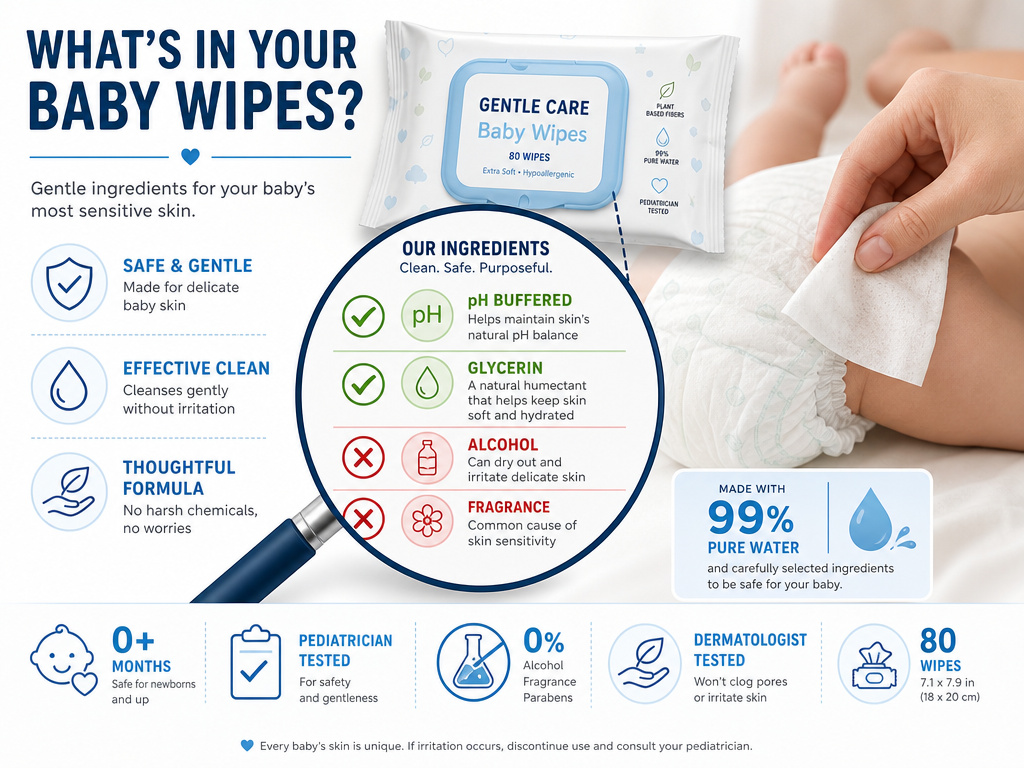
If you’re using a wipe, its ingredients matter more than its marketing. A “water wipe” isn’t automatically better. Look for three things on the label: what it has, what it lacks, and what it does.
First, it should lack common irritants. Avoid wipes with alcohol, fragrance, and harsh surfactants like sodium lauryl sulfate. These can strip and irritate sensitive skin. Second, look for positive ingredients like glycerin for light moisturization and a stated pH buffer system. The buffer is what does the heavy lifting to maintain skin health.
| Wipe Feature | Why It Matters | Example to Look For |
|---|---|---|
| pH Buffered | Counters alkaline urine-stool mix; keeps skin in safe acidic zone. | “pH balanced” or “maintains skin’s natural pH” |
| Alcohol-Free | Prevents drying and stinging on sensitive or broken skin. | “No alcohol” or “alcohol-free” clearly on label |
| Fragrance-Free | Eliminates a common source of allergic contact dermatitis. | “Fragrance-free” (not “unscented,” which can use masking scents) |
| With Emollients | Adds a light protective layer to support the skin barrier. | Ingredients like glycerin or panthenol |
My default pick for everyday use is a fragrance-free, pH-buffering wipe like Pampers Sensitive Wipes. The clinical data on their pH performance is published and clear. For parents who prefer a simpler ingredient list, a well-reviewed “water wipe” like WaterWipes can work, but remember it lacks the pH buffer, so you’re relying on the diaper alone to manage that chemistry.
Always do a patch test with a new wipe. Use it on a small area of your baby’s skin (like the thigh) for a day or two. If you see no redness or reaction, it’s likely safe for regular use. And no matter the wipe, the final step is non-negotiable: let the area air dry completely or pat it gently with a dry cloth before closing up the fresh diaper.
The Step-by-Step Routine for Any Change
Your goal is consistent: remove irritants, preserve skin pH, and ensure total dryness. Here’s how to adapt your routine based on what’s in the diaper.
For a Pee-Only Change:
- Open the diaper and check. If the skin looks clean and dry, you can often skip to step 4.
- If the skin feels damp, gently pat it dry with a soft, clean cloth or a dry corner of a disposable wipe.
- Look for any concentrated wetness in skin folds (like the groin or thigh creases). Dry these thoroughly.
- Apply any diaper cream if needed, and fasten the clean diaper.
For a Change with Stool:
- Use the front of the dirty diaper to scoop away the bulk of the mess.
- Take a fresh wipe. For a girl, always wipe a baby girl from front to back to prevent urinary tract infections. For a boy, clean a baby boy thoroughly, making sure to clean under the scrotum.
- Use as many wipes as needed until the wipe comes away clean. Don’t scrub.
- Lift the baby’s ankles to gently clean the entire bottom and lower back.
- This is the critical moment. Let the area air dry for 15-30 seconds. You can fan it with the clean diaper. Skin must be completely dry before the next step.
- Apply a barrier cream or ointment if your baby is prone to rash.
- Secure the new diaper.
Before you start: Always wash your hands first. Have all supplies, clean diaper, wipes, cream, a dry cloth, within arm’s reach before you lay the baby down. Never leave a baby unattended on a changing surface.
The difference between the two routines is the cleansing agent. For stool, a wipe is non-negotiable. For pee, drying is the primary task. This tailored approach minimizes unnecessary skin contact and keeps the routine efficient, which helps if your baby hates diaper changes.
Special Circumstances and Rules
The “wipe for poop, dry for pee” rule is a home guideline. Other settings have different protocols, often for good reason.
In licensed childcare centers, the rulebook is literal. For example, Texas diaper change regulations mandate that a caregiver must “thoroughly cleanse children with individual cloths or disposable towels” at every change. This is a health code requirement to prevent the spread of germs in a group setting. At daycare, they will wipe every time.
For babies with sensitive skin or conditions like eczema, you might need to wipe at every change, but with a specific product. You’d choose a gentle baby wipe formulated for that purpose and follow up immediately with a recommended moisturizer. The priority shifts from minimizing contact to controlling the environment with the gentlest possible tools.
During illness, especially diarrhea, all bets are off. Stool is more frequent, more acidic, and contains more active enzymes. In this case, proactive use of a pH-buffering wipe at every change, even if you think it’s just pee, can help neutralize the skin surface faster. Be extra vigilant about drying and apply a thick barrier cream like zinc oxide paste with every new diaper. It’s damage control.
Frequently Asked Questions
Do you need to wipe a baby girl after pee?
You do not typically need to wipe a baby girl after a pee-only diaper change. The key is to ensure the skin is dry. If the skin feels damp, pat it dry gently with a soft cloth. Always remember to wipe a baby girl from front to back when cleaning stool to prevent bacteria from spreading to the urinary tract.
What happens if you don’t wipe baby after pee?
If the diaper was only wet with urine and you ensure the skin is completely dry before rediapering, nothing bad happens. Modern diapers are highly effective at wicking moisture away from the skin. Problems arise only if wet skin is sealed into a new diaper, creating a damp environment that can chafe and weaken the skin barrier over time.
Can I use water instead of wipes for pee?
Yes, you can use water and a soft cloth to dampen and clean the area if you prefer, but it is an extra, often unnecessary step. The most important action is drying. Using plain water requires you to then thoroughly dry the skin, which can take longer than simply patting dry after a superabsorbent diaper has done its job.
Why does my baby get a rash even when I wipe every time?
Frequent wiping with a harsh or irritating wipe can be the cause. Over-wiping damages the skin’s protective barrier. More commonly, the issue is not drying the skin completely before applying the new diaper. Moisture trapped against the skin, combined with the friction of the diaper, is a primary rash trigger. Check your diaper change timing as well, as longer intervals in a wet or soiled diaper increase risk.
Are some wipes better for just pee?
For pee-only changes where you choose to wipe, the gentlest option is a wipe designed for sensitive skin. A simple, fragrance-free water wipe can be sufficient since you’re not fighting oily stool residues. However, if your baby is prone to rashes, using a pH-buffering wipe even for pee can help maintain an optimal skin environment proactively.
Before You Go
The science simplifies the decision. Don’t wipe after pee just because you think you should. Check the skin. If it’s dry, move on. If it’s damp, pat it dry. Save the wipes for the real mess.
Invest in a good, pH-buffering wipe for stool changes, it’s a tool that works on a chemical level, not just a physical one. And no matter what, make “bone dry” your mantra before that clean diaper gets fastened. That single habit prevents more rashes than any magic cream or wipe ever could.
For everything else, from preventing nighttime leaks to choosing the right changing gear, the principle is the same. Understand the mechanism, then act on what matters. Your baby’s skin will thank you.
