
What Diaper Genie Filters Trap | The 90-Day Carbon Cycle
This post contains affiliate links. As an Amazon Associate, we learn from qualifying purchases
Diaper Genie filters trap volatile organic compounds (VOCs)—the gaseous molecules that carry smell—using a sheet of activated carbon. This filter works by adsorption, where odor molecules stick to the carbon’s vast internal surface area. The official Playtex manual for the Diaper Genie Complete states to replace this carbon filter every 3 months for optimal performance.
That three-month timeline marks the point at which the carbon’s pores fill up and the filter stops working, turning your pail from an odor trap into a sealed container that’s just waiting to be opened.
This guide walks through the two-part system: the physical seal of the 7-layer bag and the chemical work of the carbon filter. You’ll learn which Diaper Genie models actually have a filter, the science of how it works, and the unmistakable signs that yours is saturated.
Key Takeaways
- The carbon filter (part H in the manual) traps gaseous odors (VOCs) through adsorption, not the solid waste or liquids.
- Only certain models, like the Diaper Genie Complete, include a replaceable carbon filter. Others, like the Diaper Genie Select, rely solely on the bag’s seal.
- Per the OEM manual, you must replace the filter every 3 months. A spent filter provides zero odor control.
- The filter is the secondary defense; the primary odor barrier is the clamp system sealing each diaper inside the 7-layer refill bag.
- If your nursery smells near a closed pail, the filter is almost certainly exhausted and needs replacement.
The Two-Part Odor Locking System
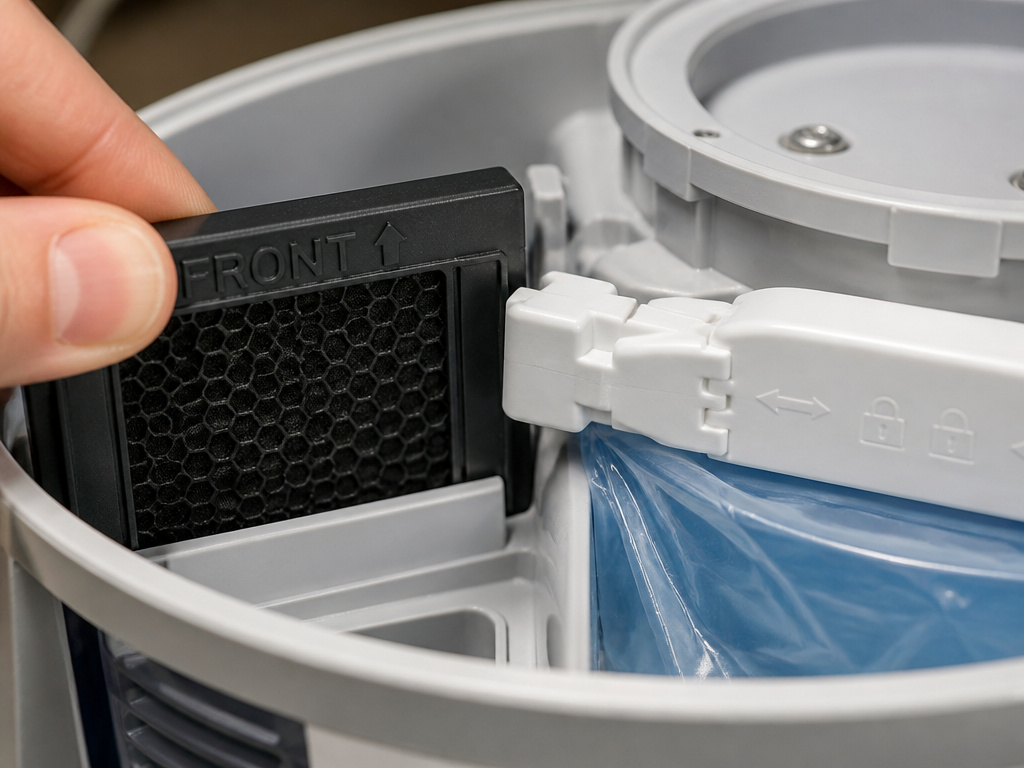
A Diaper Genie doesn’t rely on magic. It uses a mechanical seal followed by a chemical trap. The first line of defense is the clam-shell clamp mechanism. When you step on the foot pedal and drop in a diaper, the internal clamps wrap the diaper in film and seal it shut, creating an individual plastic pouch inside the larger refill bag. This physical barrier contains the bulk of the smell at the source.
The second line is the carbon filter, designated as part H in the Playtex instruction manuals. This filter is a flat, often black, sheet of activated carbon housed in a plastic frame that slides into the pail’s head. Its job is to catch the volatile organic compounds that inevitably escape the microscopic seams of the plastic seals or diffuse through the bag material over time. Think of it as a final scrubber for the air inside the pail’s headspace before any scent can leak into the room.
Where this goes sideways: Assuming the filter handles the main smell. The clamps and bag do the heavy lifting. The filter is for the residual gases that sneak past. If the clamps jam or the bag tears, no filter on earth will save your nursery’s air.
Bag vs. Filter: What Actually Holds the Smell?
It’s critical to separate the roles. The proprietary 7-layer refill bag with barrier technology is designed to lock in germs and moisture. The carbon filter only tackles airborne odor molecules. If you see liquid or solid waste, that’s a bag or clamp failure, not a filter issue.
| Component | What It Traps/Contains | Failure Signs | Fix |
|---|---|---|---|
| 7-Layer Refill Bag | Moisture, solids, bacteria. Provides the primary physical barrier. | Visible leaks, tears, difficulty feeding film. | Replace the liner. Ensure you’re using official or compatible refills. |
| Clamp Mechanism | Seals each diaper individually inside the bag film. | Lid won’t open, diaper doesn’t seal, loud grinding noise. | Clear jam, ensure bag is threaded correctly. May require common Diaper Genie problems troubleshooting. |
| Carbon Filter (H) | Gaseous odors (VOCs). Adsorbs smell molecules from the air inside the pail. | Nursery smells when pail is closed. No physical leaks present. | Replace filter every 3 months per manual. |
Which Diaper Genie Models Have a Filter?
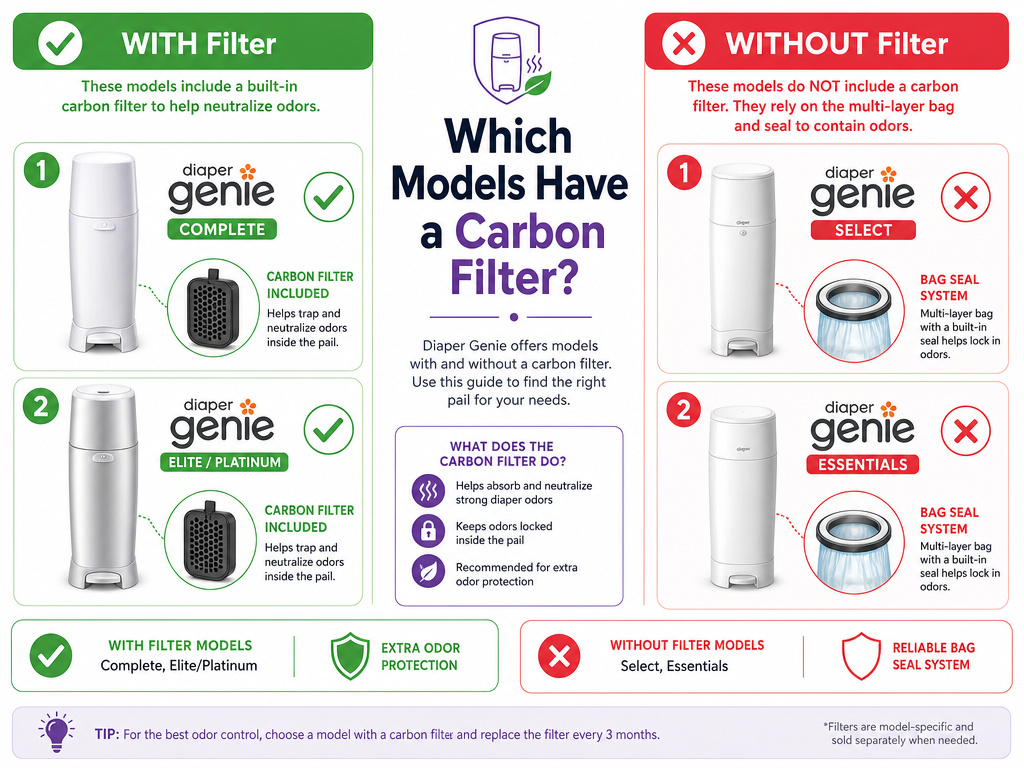
Not all Diaper Genies use a carbon filter. The design choice splits the lineup, impacting both upfront cost and long-term maintenance.
Models WITH a Carbon Filter:
- Diaper Genie Complete: This model explicitly includes the carbon filter (H). The manual dedicates steps to its installation and replacement. It’s the flagship for multi-layer odor control.
- Diaper Genie Elite & Platinum: These upgraded models also typically include carbon filtration, often with additional antimicrobial claims about the plastic itself.
Models WITHOUT a Carbon Filter:
- Diaper Genie Select: This newer, more compact pail relies exclusively on the seal of its square refill cartridges. It forgoes the carbon filter, simplifying design but placing the entire odor-control burden on the bag’s integrity.
- Diaper Genie Essentials: The basic model often operates without an additional filter, depending on the bag system alone.
The part nobody mentions: The plastic body on some non-filter models can become a problem. A 2017 BabyGearLab comparison noted that the plastic of a competing pail absorbed odors over time and couldn’t be washed out. Playtex states some models use antimicrobial plastic to prevent this. A carbon filter helps keep the air inside the pail cleaner, which may protect the plastic itself from smelling.
The Science Behind the Filter: Activated Carbon & VOCs
Activated carbon is carbon treated with oxygen to open up millions of microscopic pores. This process creates a massive internal surface area—a single gram can have a surface area exceeding 3,000 square meters.
Volatile Organic Compounds (VOCs) are carbon-based molecules that evaporate easily at room temperature, carrying odors. In a diaper pail, these come from urine (ammonia, amines) and feces (sulfur compounds, indoles).
Activated carbon filters work through adsorption (with a ‘d’), not absorption. Odor molecules in the air drifting through the filter get physically trapped and held on the vast pore surfaces of the carbon by weak intermolecular forces (van der Waals forces). It’s like molecular Velcro.
This is a passive, chemical process. No power required. But the pores have a finite capacity. Once most of the binding sites are occupied by odor molecules, new VOCs simply pass through. The filter is now saturated. This is why the manufacturer’s 3-month replacement directive is based on chemistry, not an arbitrary schedule.
Why-Layer: The “activation” process creates a lattice of cracks and pores. Different pore sizes trap different molecules. The mix in a diaper pail requires a broad spectrum of pore sizes, which high-quality activated carbon provides. Cheap filters might activate poorly, leaving fewer pores and less capacity.
How to Know When Your Filter is Saturated
The carbon filter doesn’t change color or look different when it’s full. You have to rely on sensory evidence and the calendar.
- The Calendar Test: The Playtex Diaper Genie Complete manual (document 93022190, revised 02/2017) states: “For optimal performance, replace carbon filter, every 3 months.” Mark your installation date. At 90 days, it’s done.
- The Sniff Test: The most reliable sign. If you can smell the pail from a few feet away while it’s closed, the filter is saturated. Odors are bypassing it and escaping through the lid seams.
- The Age Test: Can’t remember when you last changed it? If it’s been through more than one full refill cartridge, it is almost certainly exhausted.
Common mistake: Waiting for a smell to change the filter. By the time you smell it, the filter has been ineffective for days or weeks. You’ve been relying on the bag seal alone. Replace on schedule, not on scent.
Replacing it is straightforward. On the Diaper Genie Complete, you press the button to open the canister, slide the old filter out of its holder (part I), and slide a new one in. No tools needed. Always have a spare on hand—you won’t want to run to the store the day it quits.
Filter vs. Filter-Free: Comparing the Diaper Genie Complete and Select
The choice between a model with a filter and one without often comes down to the Diaper Genie Complete versus the Diaper Genie Select. Here’s the head-to-head breakdown.
| Feature | Diaper Genie Complete (with Filter) | Diaper Genie Select (Filter-Free) |
|---|---|---|
| Primary Odor Control | 7-layer bag seal + 3-month carbon filter. | Square refill cartridge seal only. |
| Refill Type | Round refill cartridge (holds ~270 newborn diapers). | Square refill cartridge (holds ~40 newborn diapers). |
| Maintenance | Replace bag + replace filter every 3 months. | Replace bag only. |
| Best For | Parents who want maximum odor security and don’t mind the extra replacement part. | Smaller spaces, parents who want simpler maintenance and empty the pail more frequently. |
| Potential Weak Point | Forgetting to replace the filter, negating its benefit. | The entire odor burden is on the single bag seal; if it fails, smell escapes immediately. |
The Select is simpler and cheaper to maintain in terms of parts. The Complete offers a backup system. For a nursery where the pail sits for a couple of days between empties, that backup can be the difference between fresh air and a faint funk.
Frequently Asked Questions
Do all Diaper Genies need a filter?
No. Only specific models like the Diaper Genie Complete, Elite, and Platinum are designed with a carbon filter slot and require it. Models like the Diaper Genie Select and Essentials do not use one. Check your manual or look for a filter slot inside the pail’s head.
Can I wash and reuse the carbon filter?
No. Activated carbon cannot be effectively regenerated by washing. Water will not remove the adsorbed VOC molecules from the microscopic pores. Once saturated, the filter must be replaced with a new one.
What happens if I never replace the filter?
The filter becomes inert. It provides no odor control, so any VOCs inside the pail will eventually seep into the room. You are relying solely on the physical seal of the bag and clamps, which increases the chance of noticeable smells, especially as the bag fills up.
Are generic replacement filters effective?
They can be, but quality varies. The effectiveness depends on the quality and amount of activated carbon used. A reputable generic brand may work fine for the 3-month lifespan. However, for guaranteed performance that matches the pail’s original design, OEM filters from Playtex are the surest bet.
Does the filter help with the smell when I open the pail to empty it?
Minimally. The filter cleans the air in the headspace above the sealed diapers. When you open the canister to empty the pail, you’re breaking the primary bag seal. A burst of odor is normal. A fresh filter might reduce the ambient smell in the room after you’ve closed it back up with a new bag.
The Bottom Line
The Diaper Genie carbon filter has one job: adsorb smelly gases for 90 days. It’s a maintenance item, not a permanent fixture. If your model has one, set a calendar reminder and replace it quarterly. If your model doesn’t have one, like the Select, your vigilance shifts to ensuring the refill cartridge is always correctly installed and the seal is intact.
For maximum odor security in a main nursery, the two-stage system of the Diaper Genie Complete is the logical choice. Just remember that the filter is the supporting actor. The star of the show is always that Diaper Genie odor-trapping system of clamps and layered film. Keep both working, and the only thing you’ll notice is the silence.
