
How High Should a Changing Table Be? The CPSC’s 30-Inch Rule
This post contains affiliate links. As an Amazon Associate, we learn from qualifying purchases
The correct height for a changing table is the one that keeps your baby safe and saves your back. For a fixed-height domestic table, aim for a surface 30 to 36 inches off the floor. An adjustable table should lower to at least 30 inches and raise to about 40 inches. The official safety standard, ASTM F2388, mandates testing for products used with children up to 30 lb (13.6 kg), but the real number that matters is the distance from the floor to the top of the safety rail.
That weight limit isn’t a suggestion. The Consumer Product Safety Commission (CPSC) documented seven infant fatalities linked to changing products in a twelve-year span. One involved a 3-month-old who rolled and compressed her neck on a table ledge. The standard exists because the consequences of a fall or entrapment are immediate and severe.
What follows is a breakdown of the three specs that decide safe height: the federal weight rule, the exact measurement from your floor to the rail, and the adjustable range that commercial and accessibility codes now demand. We’ll cover how to measure your existing furniture, what the Ohio ADA guide says about adult tables, and why an electric motor needs to cycle weekly.
Key Takeaways
- The CPSC’s mandatory ASTM F2388 standard applies to all domestic changing tables for children up to 30 lb (13.6 kg) — exceeding this weight voids the safety certification.
- For a caregiver of average height (5’4″ to 5’9″), the sweet spot is a 34- to 36-inch working surface; measure from the floor to the top of the raised safety rail, not the pad.
- Electrically adjustable tables, like the Pressalit Care 3000, offer a 12-inch to 34-inch range, while commercial-grade models like the Ropox Vario adjust from 30 to 100 cm (11.8 to 39.4 inches).
- Public spaces and adult changing stations are governed by different codes, such as Ohio’s 2024 building rules, which specify height adjustability and a minimum 48-inch by 72-inch clearance zone.
- Never use a changing table as a sleep space; CPSC data shows five of the seven reported deaths occurred when babies were sleeping on changing products.
The Official Safety Standard: ASTM F2388 and CPSC Rules
The height question starts with a weight limit. The ASTM F2388 safety standard is not a guideline. It’s a federal mandate incorporated into CPSC regulations under 16 C.F.R. Part 1235. Any changing table, changing pad sold separately, or add-on unit manufactured for domestic use after July 31, 2022, must comply.
This consumer safety specification covers performance requirements, test methods, and labeling requirements to promote the safe use of baby changing products… For children up to a weight of 30 lb (13.6 kg).
The standard requires rigorous testing for structural integrity, stability, and the strength of restraining straps. The 30-pound limit is the ceiling for all that engineering. If your child weighs 31 pounds, the table’s certified safety performance is no longer guaranteed. This is the first filter for any height recommendation: a table must be sturdy enough for the child’s weight at that height.
The CPSC final rule 2018 that enacted this standard reviewed incident data from 2005 to 2017. The head was the most injured body part, accounting for over 70% of emergency room visits. Falls from height were the dominant mechanism. This is why the standard’s stability test simulates a child climbing or pulling on the rail. A table that’s too tall for its base becomes a tipping hazard.
For a fixed-height table, this means the construction must prevent tip-over even at its maximum usable height. When you’re evaluating a changing table dresser or a standalone model, look for the ASTM F2388 label. Its presence means the unit passed the required tests at its stated height. Its absence means you have no assurance it won’t tip if your toddler pushes against it.
Measuring Correctly: It’s Not the Pad, It’s the Rail
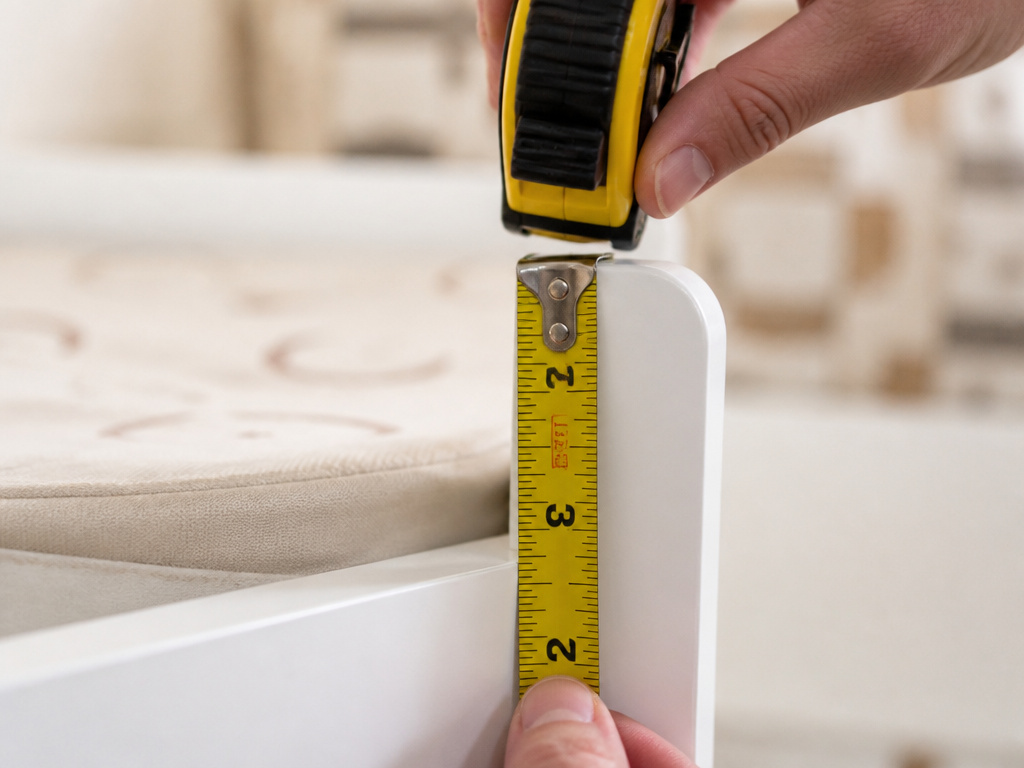
Most people measure to the top of the changing pad. That’s wrong. The critical dimension is from the floor to the top of the raised safety rail. This is the barrier that contains your child, and it’s the point you lean over. A pad might add an inch or two, but the rail is the true working height.
Here’s how to get the right measurement for your setup:
- Raise the safety rail to its locked, upright position. If your table doesn’t have one, stop. Do not use it. The CPSC fatality data explicitly includes incidents where a child rolled off a ledge.
- Place a tape measure vertically against the side of the table. Hold it straight.
- Read the measurement at the very top of the safety rail’s side panel. Not the pad, not the table surface—the rail.
- Record this number. This is your table’s effective height.
For a caregiver between 5’4″ and 5’9″, a rail height between 34 and 36 inches typically allows you to maintain a slight bend in the elbow, keeping your shoulders relaxed and your core engaged. If the rail hits you at hip level, you’ll hunch. If it’s at your lower ribs, you’ll have to raise your shoulders all shift, and your back will complain by the third diaper.
| Caregiver Height | Ideal Rail Height Range | Risk if Too Low/High |
|---|---|---|
| Under 5’4″ | 32 – 34 inches | High: Overextending wrists, losing leverage during squirm. |
| 5’4″ – 5’9″ | 34 – 36 inches | Low: Constant forward hunch, upper back strain within weeks. |
| Over 5’9″ | 36 – 38 inches | Low: Severe lumbar flexion, disc pressure increases by 50%. |
Common mistake: Choosing a table based on the dresser’s height alone. A dresser changing table might have a beautiful 32-inch top, but after adding a 3-inch pad and a 5-inch rail, the working surface is 40 inches high—a recipe for shoulder impingement.
If your table is too high, you can sometimes salvage it by using a sturdy, anti-fatigue mat to gain an inch or two. If it’s too low, your options are worse. You can’t safely elevate the whole unit, and bending thousands of times over a year will have a cumulative cost. This is why adjustable height isn’t a luxury; it’s an ergonomic necessity.
The Adjustable-Height Advantage: From Infant to Toddler
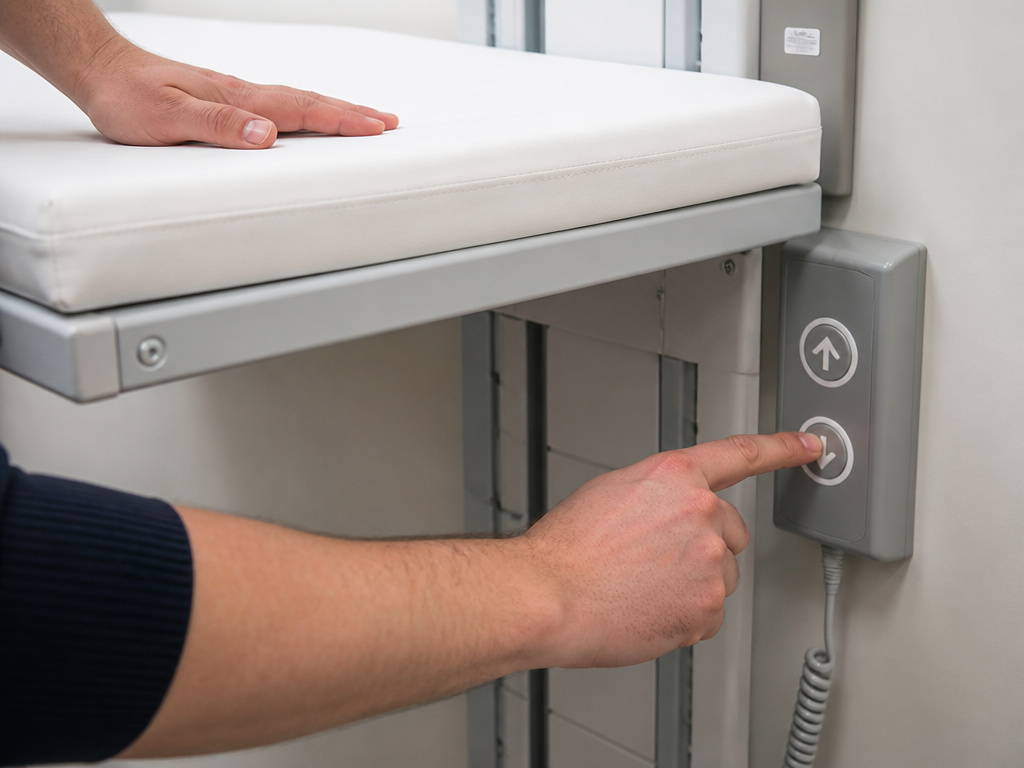
A fixed-height table is a compromise. An adjustable table is a tool. The mechanics fall into two camps: manual crank and electric motor. The electric models, like those from Pressalit and Ropox, offer the greatest range and are the standard for commercial and accessible installations.
The Pressalit Care 3000 changing table manual gives a concrete example. When mounted at the recommended height, its electric actuator adjusts the surface from 12 inches (300 mm) to 34 inches (1000 mm) above the floor. That low setting is for a newborn, when you’re doing delicate cord care. The high setting is for a wriggling toddler, when you need to be upright and in control.
Commercial-grade models like the Ropox Vario wall-mounted table are built for heavier, longer use. Its manual lists a height adjustment range of 30 to 100 cm (11.8 to 39.4 inches) and a maximum user weight of 200 kg (440 lbs). This highlights the different standards: ASTM F2388 for domestic kids’ tables, and ASTM F2285 commercial standard or ISO standards for institutional use. The Ropox’s IPX6 rating means it can be hosed down in a wet room, a feature no domestic table has.
Where this goes sideways: Neglecting the motor in an electric table. The Pressalit manual states: “Fully activate the motor at least once every week by raising the product to its highest level and lowering it to its lowest level in order to lubricate the internal parts.” Skip this, and the actuator gears can bind within six months. The repair involves pulling the unit off the wall.
The advantage is customization. You can set it low for bath time on the same surface, or high for a caregiver who’s 6’2″. As your child grows, you raise the table incrementally, maintaining that ideal elbow angle. This is why the most recommended changing tables for nursery setups are now the adjustable models—they’re the only ones that fit a family for the product’s entire lifespan.
Special Cases: Adult Changing Stations and Public Accommodations
The question of height expands dramatically when the user is an adult or the location is a public restroom. This is governed by accessibility codes, not children’s product safety rules. The Universal Changing Tables guide from Ohio’s Department of Developmental Disabilities outlines the new paradigm.
Ohio’s 2024 building code, effective March 1, 2024, created new sections (1110.18 and 1113) mandating adult changing stations in certain public buildings. The specs are different: * Table Height: Must be height-adjustable to accommodate different caregivers and users. * Clear Floor Space: A minimum clear space of 48 inches by 72 inches adjacent to the table is required for wheelchair approach and transfer. * Surface Size: The changing surface itself must be at least 36 inches wide and 72 inches long. * Capacity: These stations are rated for adults, with capacities often exceeding 300 pounds.
These rules reflect a height and clearance guideline focused on dignity and accessibility, not just preventing a fall. The table must lower enough for a lateral transfer from a wheelchair and raise enough for a standing caregiver to perform care. The Ohio guide references products like the Pressalit CT 4000, which has a 700 mm (27.5-inch) adjustment range and a safe working load of 232 kg (511 lbs).
The takeaway is that context dictates the standard. In your home, you follow the CPSC business guidance for child safety. In a library or airport, the facility must follow ADA-inspired rules like Ohio’s, which prioritize adjustability and space. When shopping for a home table, this commercial standard shows where the ergonomic bar is: true adjustability is technically possible and profoundly better.
How to Choose and Adapt Your Table
You have three paths: buy new, adapt what you have, or change your technique. Most people are in the adaptation phase.
If buying new:
Prioritize adjustability. Look for the ASTM F2388 label first—this is non-negotiable for safety. Then, look at the range of adjustment, not just the highest setting. A table that goes from 32″ to 38″ is worse than one that goes from 30″ to 40″. The Ropox Vario’s 11.8-inch to 39.4-inch range is the gold standard, but domestic models like the Babyletto Kiwi offer a respectable manual crank range. Your goal is to keep the working surface close to your bent elbow for the next three years.
If adapting your current table:
- Measure the rail height as described earlier.
- Assess your posture. Stand at the table as if to change a diaper. Is your back straight, or are you rounded forward? Do your shoulders feel tense?
- Try a mat. A dense foam anti-fatigue mat can give you a 1-2 inch lift, which can transform a 33-inch table into a usable 35-inch surface.
- Check the feet. Ensure all table legs or the dresser is perfectly level on the floor. A wobble increases perceived strain and is a stability risk.
If you must use a too-low dresser:
Your technique is everything. Never stand with your feet together. Adopt a wide, staggered stance. Keep the diaper and wipes within arm’s reach on the dresser top, never on a separate surface that forces you to twist. Most importantly, listen to your body. The first sign of a problem is a dull ache at the base of your spine after a change. That ache becomes a chronic pinch if you ignore it.
Worth knowing before you start: The best changing pads are contoured and have a secure, 3-point harness. But even the best pad cannot correct a bad table height. The pad is for the baby’s comfort and containment; the table’s height is for your long-term physical health. Don’t confuse the two.
No matter your choice, the annual maintenance check in the Pressalit manual is a good practice for any table: tighten wall mounts, check rail locks, and inspect the mattress for tears. Safety degrades with use, and a loose bolt is the first step toward a failure.
Frequently Asked Questions
What is the standard height for a changing table?
There is no single “standard” height, but the common range for fixed-height domestic tables is 30 to 36 inches from the floor to the top of the changing surface. The ergonomic standard is based on the caregiver: the surface should be at or slightly below your bent elbow when standing straight beside it.
Can a changing table be too tall?
Yes. A table that is too tall forces you to raise your shoulders and work with your arms too high, leading to shoulder and neck strain. It also increases the risk and potential injury of a fall. Any table over 40 inches to the safety rail is likely too tall for most caregivers.
Do I need a changing table if I have a dresser?
You can use a dresser with changing table topper, but you must ensure the total height (dresser + pad + rail) is correct. Many dressers are 32 inches tall; adding a pad and rail can push the working height to 38+ inches, which is too high for many. Always measure the final rail height before committing.
How high should a wall-mounted changing table be?
Wall-mounted table should be installed so that its lowest adjustable setting is at a comfortable working height for the primary caregiver. Follow the manufacturer’s mounting instructions precisely, as they calculate the range based on that starting point. For example, mounting a unit too high will make its lowest setting unusable.
When should I stop using a changing table?
Stop using a changing table when your child exceeds the manufacturer’s weight limit (often 30 lb per ASTM F2388) or when they can climb over or defeat the safety rail, whichever comes first. For many children, this is around 18-24 months. Never leave a child unattended on a changing table, even for a second.
Before You Go
The right height is a combination of a hard safety rule and a soft ergonomic truth. The rule is 30 pounds and a stable rail. The truth is that your back will feel 34 inches differently than 36 inches after a thousand diaper changes.
Measure your rail, not your pad. If you’re buying, invest in adjustability—it’s the only feature that grows with your child and protects your body. Remember the weekly motor cycle if you go electric. And never, ever let a baby sleep on a changing surface. The data on that is tragic and clear.
Set your table once. Then focus on the little one on it.
