
Do Airplanes Have Changing Tables | The Fleet-Wide Reality
This post contains affiliate links. As an Amazon Associate, we learn from qualifying purchases
Most airplanes on major domestic and international routes have at least one fold-down changing table in a lavatory, but they are not guaranteed. JetBlue and Southwest install them on every aircraft. Regional jets and older planes often lack them entirely, leaving parents to improvise on a closed toilet seat.
That guarantee from two airlines is the exception, not the rule. The presence of a changing table is an airline purchasing decision, not a federal requirement for passenger aircraft. Its installation depends on the aircraft type, its age, and whether the carrier chose to spec it from the manufacturer.
What follows is the fleet-by-fleet breakdown, the safety fine print most parents never see, and the step-by-step workarounds for when you board a plane and find nothing but a sink and a toilet.
Key Takeaways
- JetBlue and Southwest are the only U.S. Carriers with changing tables on every aircraft in their fleet.
- Regional jets (like the CRJ-200 or Embraer E175) frequently lack changing tables; always assume your short-hop flight won’t have one.
- Officially installed tables like the ASI Model 9015 have a 50-pound child weight limit, but the unit itself is tested to hold 300 pounds including an adult leaning on it.
- A 2012 European safety bulletin documented incidents where infants’ fingers were trapped in the folding mechanisms of specific Airbus lavatory tables, leading to redesigned parts.
- Your most reliable backup is a disposable pad on the closed toilet seat, not the floor, seatback tray, or your lap.
Which Airlines Have Changing Tables on Every Flight?
Only two U.S. Airlines guarantee a changing table on every single flight: JetBlue and Southwest. This is a firm fleet-wide policy. For every other carrier, it’s a question of aircraft type and configuration.
American Airlines, for example, stated that as of 2007, all but 13 of its 673 airplanes had at least one lavatory with a table. Their wide-body planes (like the 777 and 787) always have them. Their narrow-body planes (like the A320 and 737) usually do, but it’s not a 100% certainty. Delta and United operate on a similar model—common on mainline aircraft, spotty on regional ones.
Common mistake: Assuming your cross-country flight on a major carrier will have a table. While likely, you should still verify with a flight attendant during boarding. The one lavatory with the table might be at the opposite end of the plane.
International long-haul flights on wide-body aircraft (Airbus A350, Boeing 777, etc.) are the safest bet. These planes are newer and configured for longer journeys where infant amenities are expected.
The true gap in coverage is with regional airlines. These operators fly shorter routes on smaller jets like the CRJ-200, CRJ-700, or Embraer E175. As the Regional Airline Association noted, many regional airplanes are not equipped with diaper-changing tables in the bathroom. Horizon Air confirmed its CRJ-700 jets have them, but that’s an option, not a standard. For a flight on a 50-seat regional jet, plan as if no table exists.
| Airline | Fleet-Wide Guarantee? | Notes & Exceptions |
|---|---|---|
| JetBlue | Yes | All aircraft, including newer A220s and older A320s. |
| Southwest | Yes | All 737 series aircraft. |
| American | No | Missing on a small number of older aircraft; regional flights uncertain. |
| Delta | No | Common on mainline (A320, 737, A330); rare on regional (CRJ-200). |
| United | No | Common on mainline; inconsistent on United Express regional flights. |
| Regional Carriers | No | Assume NO table on flights operated by carriers like SkyWest, Endeavor Air, or Republic Airways. |
The Tight Reality of Airplane Lavatory Changing Stations

If you find a table, it’s a fold-down unit mounted to the lavatory wall, typically above the toilet. The most common model in U.S. Aircraft is the ASI Vertical Baby Changing Station (like Model 9015 or 9017).
These units have specific, tested limits that are worth knowing because they’re not just about your baby’s weight. The manufacturer’s manual states the station is “intended for use with a child of no more than 50 lbs (22.7 kg) and age up to 3.5 years.” However, the entire unit is engineered to “support a load of up to 300 lbs (136.1 kg) including baby, any items hung on bag hooks and any leaning weight of attendant.”
That 300-pound rating is for the wall anchors and the table’s structure. It means the table can handle the scenario where you have to lean against it to steady yourself in turbulence. The 50-pound child limit is a safety guideline for the restraint system and the table’s size. A toddler over 50 pounds likely won’t fit securely on the short pad.
Always use the safety strap. It’s there because the table is small and a wriggling baby can roll off in seconds. The lavatory might lurch without warning.
Where this goes sideways: Not checking the latch before you lay your baby down. The folding mechanism must click firmly into place. A table that isn’t fully latched can collapse.
There is a documented safety history here. In 2012, the European Union Aviation Safety Agency (EASA) issued Safety Information Bulletin 2012-07 after reports that passengers, including an infant, trapped fingers in the folding arms of specific Diehl Comfort Modules baby nursing tables on Airbus A320-family aircraft. The bulletin led to redesigned tables and warning placards. The mechanism is robust, but it’s a moving part in a tight space. A quick visual check takes two seconds.
Your Backup Plan When There’s No Table
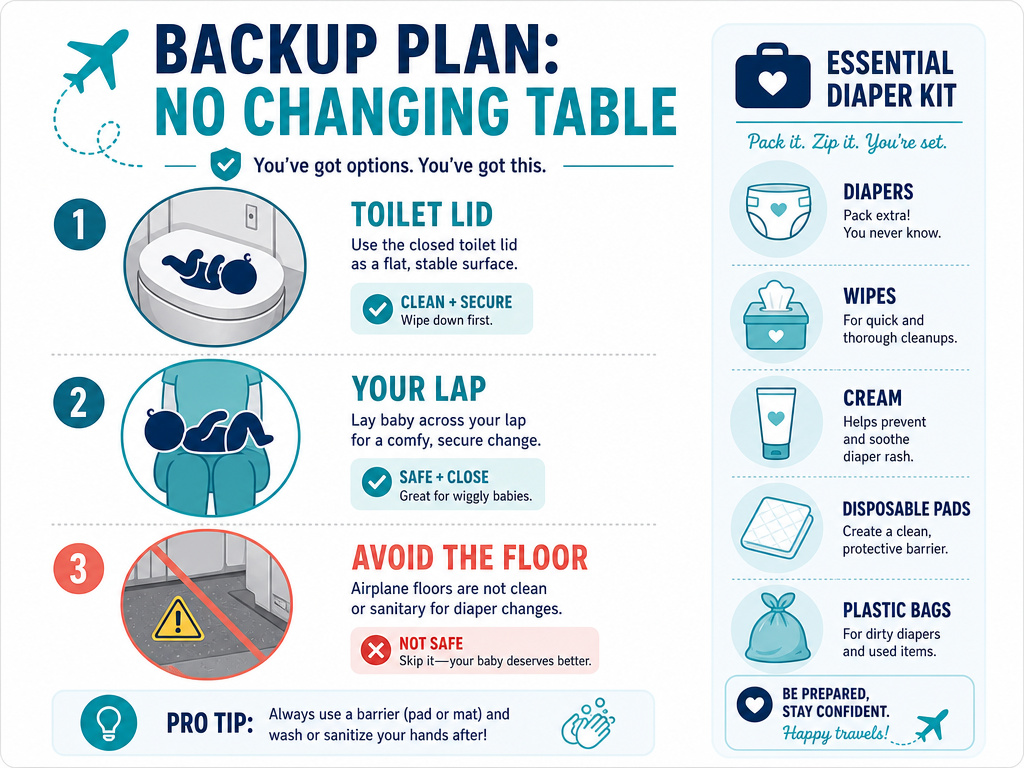
When there’s no table, you have three realistic options, ranked from most to least viable. The goal is speed, containment, and minimal disruption.
Option 1: The Closed Toilet Seat.
This is the standard fallback recommended by flight attendants and seasoned travel parents. It’s not glamorous, but it’s a stable, contained surface. 1. Lay a disposable changing pad or a few paper towels on the closed lid. 2. Assemble everything—clean diaper, wipes, bag—on the sink counter or in your lap first. One-hand operation is key. 3. Change the diaper as quickly as possible, keeping one hand on your baby at all times. The seat is narrow. 4. Seal the dirty diaper in a plastic bag (like a grocery bag or a dedicated scented disposal bag) before placing it in the lavatory trash. This is a courtesy every passenger near that trash will appreciate.
Option 2: The “Across Your Lap” Maneuver.
Some parents advocate sitting on the closed toilet seat and laying the baby across their knees. This works for small infants but becomes a precarious balancing act with a larger baby who can arch their back. It also requires significant core strength and leaves you with no free hand if you drop a wipe.
Option 3: The Floor (A Last Resort).
The floor in front of the lavatory door or in the small galley area is sometimes suggested. It is objectively the least sanitary surface on the entire aircraft. It’s also a high-traffic zone for crew and passengers. If you must do this, use a thick, waterproof pad and be prepared for a flight attendant to politely ask you to move. It’s a safety hazard in a walkway.
Skip this if: You’re considering the seatback tray table or an empty passenger seat. This is inconsiderate and unhygienic. Tray tables are cleaned infrequently, and no fellow passenger wants to sit where a diaper was changed. Just don’t.
What to Pack in Your Diaper Kit:
Don’t bring your whole diaper bag into the lavatory. There’s no room. Pack a small clutch or ziplock bag with the absolute essentials: * 2-3 diapers * Travel-size wipes pack * Small tube of diaper cream * 2-3 disposable changing pads * 3-4 small plastic bags for waste
How to Find Out Before You Fly
You can’t always trust the airline’s website or seat map. Proactive reconnaissance saves mid-flight stress.
- Call the Airline. This is the most reliable method. Ask the agent: “Does the specific aircraft scheduled for flight [number] on [date] have a baby changing table in any lavatory?” They have access to the equipment manifest.
- Ask at the Gate. While boarding, politely ask the gate agent or a flight attendant. They can often check or tell you which lavatory has the table (e.g., “the middle lavatory in the back”).
- Change in the Airport. Always make the final diaper change in the airport terminal immediately before boarding. Airport facilities are larger, cleaner, and more predictable. This minimizes the number of changes you’ll need in the air.
Frequently Asked Questions
Are airlines required by law to have changing tables?
No. There is no U.S. Federal regulation that mandates diaper changing tables on passenger aircraft. Their installation is governed by the FAA lavatory accessibility rule (14 CFR 121.313), which addresses accessibility features but does not specifically require changing stations. It is an airline amenity decision.
What if I’m on a long flight with no table?
Stick to the closed toilet seat method. For a particularly messy situation, you can ask a flight attendant if they can spare a blanket or towel to line the surface. Be prepared, be quick, and double-bag the waste. Managing this scenario is why packing a dedicated travel diaper changing pads is non-negotiable.
Can I change my baby at my seat?
You should not. It’s disruptive to seatmates and poses a sanitation issue. The only potential exception is for a very minor, dry diaper change on an infant held securely in your lap, with a pad underneath. For anything involving mess, use the lavatory.
Do international flights have them?
Yes, almost universally. Long-haul wide-body aircraft used for international travel are almost always equipped with changing tables. It’s on shorter domestic and regional routes where availability becomes inconsistent.
What’s the best diaper bag for plane changes?
The best bag is one that allows you to quickly pull out a small, organized kit. Many diaper bags with changing pads include a detachable pad that doubles as a mini-station. Look for a bag with external pockets so you don’t have to dig through the main compartment while juggling a baby in a cramped space.
Before You Go
Assume your flight might not have a changing table, especially if it’s on a small regional jet. Your strategy is simple: pack a slim kit with disposable pads, verify with the airline or crew when you board, and default to the closed toilet seat method. The real convenience comes from a reliable portable changing pad and knowing the fleet policies of your airline. JetBlue and Southwest remove the guesswork; for everyone else, a little preparation replaces luck.
