
Is Aveeno Baby Wash Safe? The Clinical Data and Key Warnings
This post contains affiliate links. As an Amazon Associate, we learn from qualifying purchases
Aveeno Baby Wash is safe for most infants when used as directed, supported by clinical studies and a manufacturer 5-step safety assurance. Its core formulation avoids soap, parabens, sulfates, phthalates, and dyes, and is centered on colloidal oatmeal, an FDA-recognized skin protectant. However, specific warnings apply to the AVEENO® Baby Eczema Therapy Soothing Bath Treatment regarding over-drying and eye contact.
The answer pivots on which product you’re holding and your child’s skin condition. The daily wash is broadly safe; the eczema therapy line carries specific, printed cautions that change the risk calculation.
What follows: the clinical data behind the safety claims, a breakdown of the three main wash lines, the exact ingredients that matter, and the manufacturer warnings most parents miss on the first read.
Key Takeaways
- Aveeno’s safety claim is grounded in an 80-year oat science history and a documented 5-step safety assurance process for ingredient selection and testing.
- A 2007 clinical study of 23 children with atopic dermatitis found the AVEENO® Eczema Therapy regimen well-tolerated and effective, with significant improvement in itch and moisturization.
- The AVEENO® Baby Eczema Therapy Soothing Bath Treatment has explicit FDA DailyMed warnings: it can over-dry skin if soaked too long and is for external use only.
- “Tear-free” means the formula’s pH matches tears to reduce stinging, it does not mean the product is safe for ingestion or prolonged eye contact.
- For general use, the Aveeno Baby Daily Moisture Wash & Shampoo is formulated without soap, parabens, sulfates, phthalates, dyes, and phenoxyethanol.
The Core Safety Framework: Clinical Data and Formulation
Is the safety claim just marketing? The distinction lies in primary sources versus aggregated reviews. Aveeno’s position rests on published clinical work and a formalized safety protocol.
The brand cites over 80 published studies and more than 30 clinical tests involving over 3,000 patients. One pivotal study is directly relevant to worried parents.
A 2007 multi-center clinical study evaluated AVEENO® Eczema Therapy Moisturizing Cream and AVEENO® Baby Cleansing Therapy Moisturizing Wash in 25 subjects aged 12 to 60 with mild to moderate atopic dermatitis. After 8 weeks, the regimen showed statistically significant improvement in Investigator Global Assessment (IGA) scores, Eczema Area and Severity Index (EASI), itch, and moisturization. The study noted the regimen was “compatible with various topical eczema medications” used by participants.
This is a blinded, IRB-approved clinical trial whose results were published in the Journal of the American Academy of Dermatology. For a parent managing eczema, that’s a different caliber of evidence than a “dermatologist-tested” label.
The manufacturer’s internal process is a 5-step safety assurance. This is a documented sequence: Ingredient Assessment & Sourcing, Formula Design & Assessment, Safety & Clinical Testing, In-Use Testing & Product Stability, and Ongoing Evaluation. When a brand publishes this level of procedural detail, it’s inviting scrutiny, a strong trust signal.
Where this goes sideways: Assuming all “Aveeno Baby” washes are identical. The clinical data applies specifically to the AVEENO® Baby Cleansing Therapy Moisturizing Wash in the eczema therapy line. The more common Aveeno Baby Daily Moisture Wash & Shampoo has its own, broader safety profile based on ingredient exclusion.
Decoding the Aveeno Baby Wash Lines
Aveeno Baby is a system, and the safety nuances change with each variant. Using the eczema wash for a baby with normal skin is unnecessary.Using the daily wash on severe eczema might not deliver the studied benefits.
| Product Line | Best For | Key Active | Critical Safety Note |
|---|---|---|---|
| Daily Moisture Wash & Shampoo | General use, sensitive skin | Oat Extract | Formulated without soap, parabens, sulfates, phthalates, dyes, phenoxyethanol. |
| Cleansing Therapy Wash (Eczema Line) | Mild to moderate atopic dermatitis | Colloidal Oatmeal (Skin Protectant) | Clinically studied. Part of a regimen with a matching moisturizing cream. |
| Eczema Therapy Soothing Bath Treatment | Soothing itchy, eczema-prone skin | Colloidal Oatmeal Powder | Has specific warnings: Can over-dry if soaked too long; for external use only; use a bath mat. |
The Daily Moisture Wash & Shampoo is your default. Its ingredient exclusions are a direct response to common parental concerns. No parabens (preservative concern), no sulfates (harsh lather agents), no phthalates (plasticizer concern), no dyes (irritant risk), and no phenoxyethanol (another preservative some avoid). It’s a tear-free, hypoallergenic formula designed for a gentle baby bath schedule.
The Cleansing Therapy Wash is a tool for a condition. Its colloidal oatmeal is not just a moisturizer; it’s an FDA-monographed OTC skin protectant active ingredient. This is the product linked to the clinical outcomes. If your child doesn’t have eczema, you don’t need this level of intervention.
Then there’s the Soothing Bath Treatment, the product with the clearest, boldest warnings. Its official FDA DailyMed label states: “In some skin conditions, soaking too long may overdry.” It also warns about getting it in eyes and advises using a mat to avoid slipping. This is the product where the “use as directed” clause carries real weight.
Ingredient Deep Dive: What’s Actually In It?
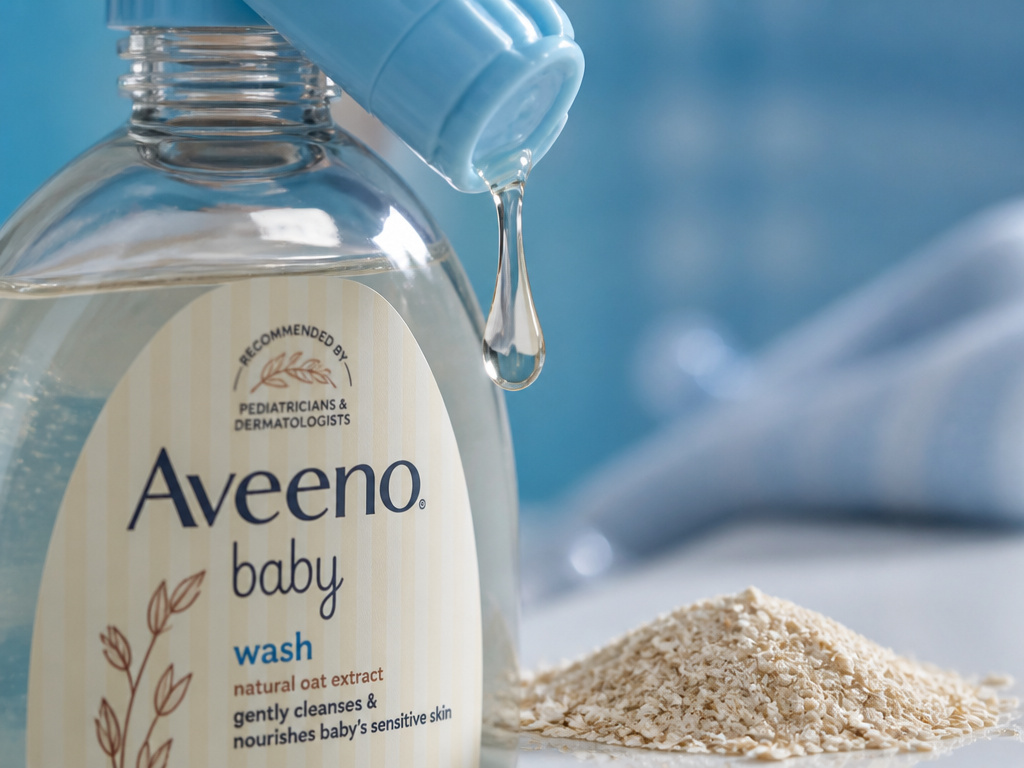
Let’s move past the “free-from” list. What’s in the bottle that makes it work, and what does the terminology actually mean for safety?
Colloidal Oatmeal is the hero ingredient. The FDA recognizes it as a skin protectant for temporarily relieving minor skin irritation and itching from eczema. In the formula, it’s finely ground oat suspended in liquid. Its mechanism is threefold: it forms a protective barrier on the skin, it has anti-inflammatory properties, and it’s a humectant that helps hold moisture. This is why it’s the centerpiece of the eczema line.
Coco-Glucoside and Glycerin are the workhorses. Coco-Glucoside is a gentle surfactant derived from coconut oil and glucose. It’s what cleans without stripping. Glycerin is a humectant that pulls moisture to the skin. Both are considered mild and are derived from vegetable sources.
Common mistake: Reading “tear-free” as “eye-safe.” Tear-free formulations are pH-balanced to match natural tears (around 7.0), which minimizes stinging. It does not mean the product is harmless if ingested or left in the eyes. Always rinse thoroughly.
The “fragrance” listed is a point of contention for some. Aveeno uses a “light, fresh fragrance” in its daily wash. While the brand states it’s hypoallergenic, fragrance is a known potential irritant for a subset of individuals with extremely sensitive skin or fragrance allergies. The Cleansing Therapy Wash in the eczema line is typically fragrance-free for this reason.
If you’re comparing, know that a randomized controlled baby wash trial published by the NIH compared a similar soap-free, pH-adjusted baby wash (Johnson’s Baby Top-to-Toe Bath) to water alone in newborns. It found no significant difference in transepidermal water loss (TEWL) at 14 days, concluding the wash was non-inferior to water for skin barrier function. This type of study helps validate the category’s approach.
Specific Warnings and How to Use It Safely
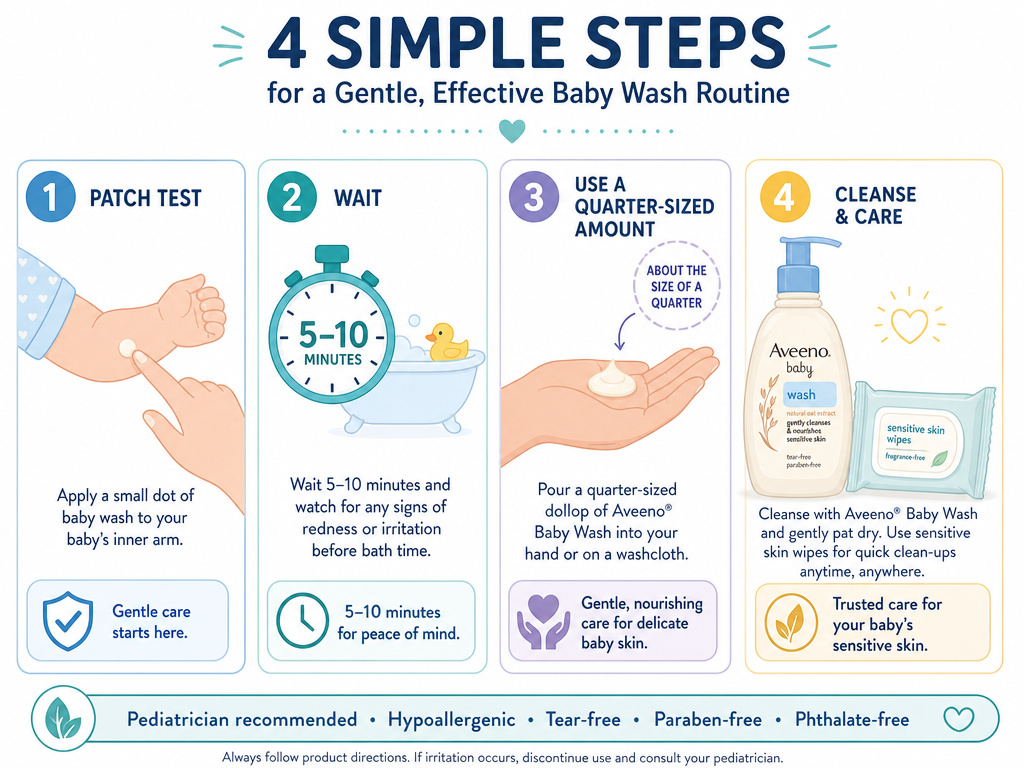
Safety is about the interaction between the product, your child’s skin, and your routine, not just the ingredients list. Ignoring the printed directives is where good products get a bad name.
First, patch test. Apply a small amount on your baby’s inner arm or leg. Wait 24 hours. Look for redness, bumps, or dryness. This is non-negotiable for any new product, especially if your family has a history of sensitive skin or eczema.
Second, follow the bath treatment warnings verbatim. For the AVEENO® Baby Eczema Therapy Soothing Bath Treatment: * Limit soak time to 5-10 minutes. The official drug labeling document explicitly warns that soaking too long can over-dry. * Use a non-slip mat. The label says it. * Rinse the skin after the soak. Pat dry, don’t rub. * Consult a doctor if symptoms last more than 7 days or recur. This is on the label for a reason.
Third, less is more. You don’t need a large amount of wash. A quarter-sized dollop is usually enough. Over-washing, even with a gentle product, can compromise the skin’s natural lipid barrier. Your bathing frequency for a newborn or infant is more important than the product itself. For most babies, 2-3 times a week is sufficient.
Fourth, integrate with other safe products. If you’re using a gentle wash, pair it with wipes for sensitive skin or water wipes for diaper changes to maintain a consistent, low-irritant routine. Avoid harsh soaps or adult body washes at all times.
Aveeno Baby Wash vs. Other Gentle Brands
How does it stack up? The honest answer is that for general use, several brands meet a similar safety profile. The differentiator is Aveeno’s specific clinical backing for its eczema line and its oat science focus.
- CeraVe Baby Wash & Shampoo: Also gentle, fragrance-free, and contains ceramides to support the skin barrier. It lacks the oat-specific clinical history for eczema but is an excellent, dermatologist-recommended alternative.
- Mustela Gentle Cleansing Gel: Uses plant-based ingredients and is fragrance-free. A favorite for many, but again, without the same volume of published oat studies.
- Babyganics Shampoo + Body Wash: Plant-based and EWG Verified. It’s a strong “free-from” option but has a different ingredient philosophy than Aveeno’s oat-centric approach.
The short version: If you have no skin concerns, several brands are safe and effective. If you are managing eczema or want the evidence of a clinically studied oat regimen, Aveeno’s therapy line has a unique position. For daily maintenance, the Aveeno Baby Daily Moisture Wash & Shampoo is a proven, conservative choice that pairs well with a routine using chemical-free baby wipes.
Frequently Asked Questions
Is Aveeno Baby Wash safe for newborns?
Yes, the Daily Moisture Wash & Shampoo is formulated to be gentle enough for newborn skin. The clinical study on the Cleansing Therapy Wash included subjects as young as 2 months. For the first few weeks, many parents prefer plain water, but if using a wash, Aveeno is a pediatrician-recommended option. Always ensure proper rinsing.
Can Aveeno Baby Wash cause allergic reactions?
Any product can cause an allergic reaction, as allergies are individual. Aveeno Baby Wash is hypoallergenic and formulated without common irritants to minimize this risk. However, if your child has a known allergy to oats (avenin), you should avoid Aveeno products. Always perform a patch test.
Is Aveeno Baby Wash safe for eczema?
The AVEENO® Baby Cleansing Therapy Moisturizing Wash is specifically designed and clinically studied for mild to moderate eczema. It is considered safe and effective as part of the branded eczema therapy regimen. The National Eczema Association product review also lists it as a suitable product, which is a meaningful endorsement from a patient advocacy group.
Does Aveeno Baby Wash have harmful chemicals?
Based on its published formulation, Aveeno Baby Wash does not contain parabens, sulfates, phthalates, dyes, or soap. It uses a blend of gentle surfactants and oat extract. The term “harmful” is subjective, but the brand excludes ingredients that are most frequently questioned by parents seeking safe wipe ingredients.
Is Aveeno Baby Wash tear-free?
Yes, it is formulated to be tear-free. This means its pH is balanced to match that of tears, which significantly reduces stinging if the product gets in the eyes. It is not, however, “no-tears” meaning it’s okay to leave in the eyes, always rinse thoroughly.
Before You Go
Aveeno Baby Wash is safe when matched to your child’s needs. The daily wash is a solid, exclusion-formula choice for most. The eczema therapy line is a rare example of a mass-market product with legitimate clinical data behind it, use it with respect for its specific bath treatment warnings.
Your best move is to identify your child’s skin type, pick the corresponding line, and follow the instructions. Pair it with a sensible infant bath schedule and gentle companion products like non-toxic wipes. The evidence says it’s a reliable choice. Your routine confirms it.
