
What Is a Changing Schedule? A Framework for Diaper Changes
This post contains affiliate links. As an Amazon Associate, we learn from qualifying purchases
A baby changing schedule is a flexible, cue-based routine for diaper checks and changes, built around three elements: time intervals (every 1-3 hours), physical cues (fussing, wake-up), and diaper condition (fullness, stool). Its goal is to prevent diaper rash by minimizing skin contact with moisture and ammonia, not to train the baby’s bladder.
That last clause is the whole point. A schedule isn’t about potty training a newborn. It’s a damage-control system for skin that hasn’t finished developing its protective barrier. The ammonia in urine breaks down that barrier faster on infant skin than on adult skin, and a full diaper holds that against them.
What follows is the framework: the three signals that tell you it’s time, the two schedules that change at the six-week mark, and the one mistake that turns a flexible routine into a source of stress for everyone.
Key Takeaways
- A changing schedule is a responsive routine, not a rigid clock. It combines time intervals with baby cues and diaper checks.
- The primary goal is to prevent diaper rash. Prolonged moisture contact is the main cause, and ammonia from urine accelerates skin breakdown.
- Newborns (0-6 weeks) need changes every 1-2 hours, about 10-12 times a day. Older infants (6 weeks+) can often go 2-3 hours, averaging 6-8 changes.
- Always change a soiled diaper immediately. For wet diapers alone, you have a short window, check within 15-20 minutes of noticing the cue.
- The most common mistake is treating the schedule as a timer. Watch the baby, not the clock.
What a Changing Schedule Actually Is (And Isn’t)
It’s not a calendar alert. It’s not something you set on your phone for 2:00 PM sharp. Those are reminders for you, but the schedule itself lives in the interaction between the baby’s needs and your observation.
A baby changing schedule is a parent-managed framework for anticipating and responding to elimination needs. It uses predictable intervals, behavioral cues, and product indicators to minimize skin irritation and support consistent care, distinct from bladder-training methods like elimination communication.
Think of it as a set of rules for a game where the baby makes the moves and you provide the cleanup. The rules are simple: check at predictable times, watch for specific signals, and act before the diaper’s capacity turns against the skin’s integrity.
Forget the word “schedule” for a minute. Call it a rhythm. Your day already has them, naptime, feeding, burping. A changing rhythm slots into those existing patterns. You check after every wake-up, before every feed, and anytime the baby gets suddenly fussy without an obvious reason. That rhythm becomes automatic within a couple of weeks.
The Core Elements of a Baby Changing Schedule
Three things tell you it’s time. Relying on just one is how you end up with a rash or a missed change.
1. Time Intervals (The Backup Timer)
This is your baseline. For a newborn, set your mental timer to 90 minutes. For an older infant, two and a half hours. These aren’t deadlines but check-in prompts. The interval resets after every change. If you changed at 9:00 AM, your next check-in is around 10:30 AM for a newborn, 11:30 AM for an infant. This interval is what most changing table organization guides are built around, having supplies within reach for these frequent check-ins.
2. Baby Cues (The Live Signal)
Babies signal. They just use a limited, confusing vocabulary. – The Post-Nap Fuss: This is the most reliable. A baby waking up dry is rare. Check within five minutes of them stirring. – The Mid-Feed Squirm: Stopping feeding to arch their back or push away often means a bowel movement is happening. Wait a minute, then check. – The Unexplained Cry: You’ve offered food, tried rocking, and the crying continues. A wet or dirty diaper is the next most likely culprit.
3. Diaper Condition (The Physical Evidence)
This is your verification. Modern diapers have two built-in tools. – The Wetness Indicator: That yellow line on brands like Huggies and Pampers. When it turns blue, the diaper’s core is saturated. This is your go/no-go signal. A blue line means change now, even if the baby seems fine. – The Sag Test: Pick the baby up. If the diaper droops noticeably or feels heavy, it’s full. This is more relevant for older infants producing larger volumes of urine at once.
Where this goes sideways: Waiting for the wetness indicator line on every change. That line marks maximum absorption, not a safe saturation level for skin. By the time it’s blue, moisture has been against the skin for at least 20 minutes. Check before the line.
| Element | What It Is | When To Act | Risk If Ignored |
|---|---|---|---|
| Time Interval | A consistent check-in prompt (e.g., every 2 hours). | Use as a baseline reminder to look for other cues. | Missed changes lead to prolonged wetness, the primary cause of rash. |
| Baby Cue | Behavioral signal (fussing, squirming, crying). | Investigate within 5-10 minutes of noticing the cue. | Misinterpreting hunger or tiredness cues, leading to distress. |
| Diaper Condition | Physical evidence (wetness indicator, sag, smell). | Change immediately for stool; within 15 min for a full wet diaper. | Ammonia burn and blistering diaper rash can develop within a few hours. |
How Often to Change a Newborn vs. An Infant
The schedule shifts dramatically around the six-week mark. Before that, a newborn’s bladder is tiny and their stool is frequent. After that, patterns consolidate.
The Newborn Schedule (0-6 Weeks)
- Frequency: Every 1 to 2 hours.
- Daily Total: 10 to 12 diaper changes.
- Why So Often: Newborn stomachs are small, so they feed every 2-3 hours. The gastrocolic reflex means they often stool during or immediately after feeding. You’re essentially changing with every feed cycle.
- The Reality: You will change a diaper, swaddle the baby, and then hear the telltale sound of another bowel movement. It happens. Have the new diaper and wipes ready before you take the dirty one off.
This high frequency is why a dedicated, well-stocked changing station is a sanity-saver in the early weeks.
The Infant Schedule (6 Weeks & Older)
- Frequency: Every 2 to 3 hours.
- Daily Total: 6 to 8 diaper changes.
- The Change: Bladder capacity increases. Stool frequency drops, some breastfed babies may go several days without one, which is normal. The schedule decouples from every single feeding.
- The Watch-Out: Fewer changes can mean more urine volume per diaper. A morning diaper after a long sleep can be extremely heavy, requiring a more thorough clean-up to prevent rash.
| Age | Change Interval | Avg. Daily Changes | Key Driver | Night Change Rule |
|---|---|---|---|---|
| Newborn (0-6 wks) | 1-2 hours | 10-12 | Feeding & gastrocolic reflex | Change if soiled; otherwise, only if very full to avoid waking. |
| Infant (6 wks+) | 2-3 hours | 6-8 | Bladder capacity & sleep cycles | Rarely needed unless soiled. Use a high-absorbency overnight diaper. |
The Connection Between Schedule and Diaper Rash
Diaper rash is a chemical burn. It’s not a sign you’re using the wrong brand; it’s a sign that wetness or stool is staying in contact with the skin for too long. A schedule is your primary defense.
Here’s the mechanism. Urine contains urea. Bacteria on the skin break urea down into ammonia. Ammonia raises the skin’s pH, which breaks down the protective outer layer. Once that barrier is compromised, even brief contact with moisture causes irritation, and friction from the diaper creates the classic red, bumpy rash.
A changing schedule works by interrupting this process. You’re removing the reactant (urine/stool) before the bacteria can produce enough ammonia to do damage.
Common mistake: Changing a wet diaper the second you notice it’s damp. Unless it’s stool, you have a short buffer. A slightly damp diaper isn’t an emergency. A soaked one that’s been on for an hour is. The goal is to prevent prolonged saturation, not to maintain perfectly dry skin at all times, that’s impossible.
When Rash Happens Anyway
Even with a good schedule, rash occurs. Its appearance tells you what to adjust. – Bright red, spotty rash in the creases: Usually a yeast (fungal) infection, often after antibiotic use. Needs an antifungal cream like clotrimazole. – Solid red patch on the buttocks and thigh folds: Classic irritant dermatitis from wetness. Tighten your change interval by 30 minutes. – Pimples or blisters: Could be a bacterial infection or severe ammonia burn. Time for a pediatrician visit.
For routine protection, a thick barrier cream containing zinc oxide (like Desitin or Triple Paste) after every change is non-negotiable. It creates a physical shield between the skin and the moisture in the diaper.
Building Your Practical Routine
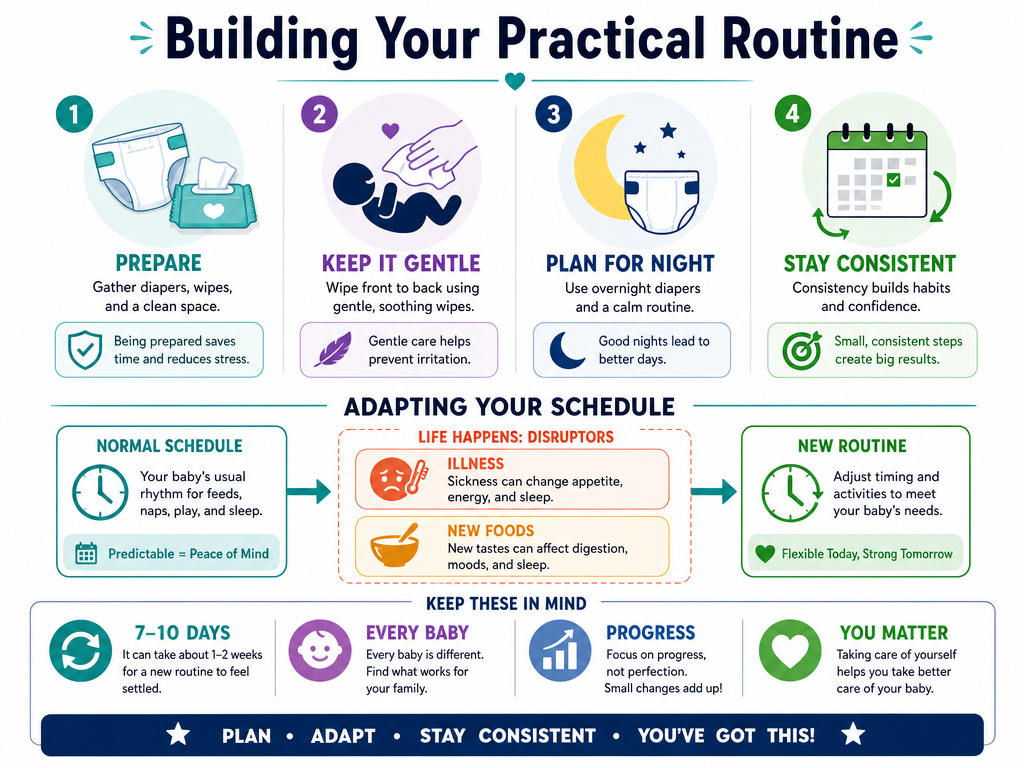
Your routine is your schedule in action. It’s the series of steps that happen from cue to clean diaper. Efficiency here prevents battles.
1. Gather Everything First.
Before you lay the baby down, have the new diaper open, wipes pulled up, barrier cream uncapped, and a change of clothes nearby if needed. One-hand access is critical. This is the principle behind every effective changing station setup.
2. The Clean-Up Sequence.
- Wipe front to back for girls to avoid urinary tract infections.
- For boys, cover the penis with a wipe or the clean diaper to avoid an unexpected shower.
- Lift the ankles gently, don’t pull the legs straight up, which can strain the hips.
- Ensure every crease is dry before applying cream. Pat dry, don’t rub.
3. The Overnight Exception.
Night changes are a trade-off between skin health and sleep continuity. The rule is simple: do not wake a sleeping baby to change a wet diaper. Use a high-absorbency overnight diaper (like Huggies Overnites or Pampers Swaddlers Overnight) and a generous layer of barrier cream at bedtime. Change only if you smell stool or the diaper is leaking.
4. Adapting the Schedule.
Growth spurts, illness, and new foods all disrupt the rhythm. Diarrhea means immediate changes with every stool, no waiting. Introducing solids often changes stool consistency and smell, requiring more vigilant cleaning. The schedule isn’t static. It’s a framework you adjust based on output.
What About Elimination Communication?
Elimination Communication (EC) is often confused with a changing schedule, but they are fundamentally different. EC is a practice of learning an infant’s elimination cues with the goal of holding them over a toilet or potty to catch waste, thereby reducing diaper use. It is a form of very early potty awareness.
A changing schedule, in contrast, has no goal of toilet training. Its sole objective is skin health and hygiene within the diaper system. You can practice EC while also maintaining a diaper change schedule for misses, and there will be many misses. The federal EPA maintenance instruction regulations underscore that any care system must be “reasonably likely to be done”; for most families, a full EC routine is not sustainable, while a flexible change schedule is.
If you’re curious about EC, start by simply observing your baby’s timing and cues for a week. You might notice they always stool ten minutes after the morning feed. That’s valuable intel for your schedule, whether you try to catch it in a potty or not.
Frequently Asked Questions
How do I know if the diaper is full if there’s no wetness indicator?
Use the sag and squeeze test. A full diaper will have a noticeable, jelly-like bulk in the center when you gently squeeze it. It will also sag lower between the legs when you pick the baby up. For cloth diapers, feeling dampness on the outside liner is the sign.
My baby hates diaper changes. What can I do?
This is common around 4-6 months when rolling begins. Keep a special “change time only” toy within your reach to distract them. A small, crinkly book or a silicone teether works. Also, ensure the surface isn’t cold, lay a soft cloth on the pad first. Sometimes, moving the changing table to a floor mat gives you more control and them less height to fear.
Should I change a diaper right after they wake up from a nap?
Yes, almost always. A long nap usually means a full bladder. Changing them into a fresh diaper as part of the wake-up routine prevents discomfort as they start their next awake period and keeps their skin dry.
Is it okay to let a baby sleep in a wet diaper overnight?
For infants over 6 weeks, yes, if you’ve taken precautions. A quality overnight diaper and a thick layer of zinc oxide cream are designed for this. The highly absorbent core locks moisture away from the skin for up to 12 hours. The benefit of uninterrupted sleep outweighs the minimal risk of rash for most babies.
How does a changing schedule help with predicting needs?
It doesn’t predict elimination. It predicts check times. By adhering to a rough interval and cue response, you statistically increase your chances of catching a wet or dirty diaper soon after it happens. Over time, you’ll notice your baby’s personal patterns, like a morning bowel movement, which lets you preemptively be ready.
Before You Go
A changing schedule is a framework, not a fetter. Its value is in giving structure to a repetitive, essential task, turning constant guesswork into a manageable rhythm. The best schedule is the one you consistently follow without stressing over the clock.
Anchor it on three things: a time interval you can remember, the baby’s clear signals, and the physical evidence in the diaper. Trust the wetness indicator, but don’t wait for it. Prioritize changes after sleep and before feeds. And invest in a good barrier cream, it’s the final layer of the schedule that protects skin between your checks.
For the gear to support this routine, from compact portable changing tables for travel to sturdy dresser changing tables for the nursery, the right station makes the schedule flow. The goal is simple: a clean, comfortable baby, and a parent who isn’t overwhelmed by the process. That’s the schedule that works.
